
Most product brands treat AI Reels like a volume game. They generate clips, add a trending audio, post daily, and wonder why sales stay flat. Volume without a sales workflow is just noise with better lighting. If you sell a physical product, a Reel earns its keep when it stops the thumb, proves the product in motion, and gives a clear next step. That is the bar this guide is built around.
This article is a practical workflow for shops and DTC brands that want AI-assisted Reels to support revenue, not vanity views. You will map hooks, product motion, captions, and posting cadence into one repeatable system. Along the way you will see where Neurollamas fits when you need faster production without losing brand control. For a broader studio overview, start at the Neurollamas social studio, then focus on the video engine when you are ready to turn stills into short product clips.
If your feed still runs on static photos, pair this Reel system with the companion guide on turning one product photo into a week of Instagram content. Still posts build recognition. Reels build urgency. You want both.
What “sells” means for a product Reel
Before you open any generator, define the outcome. A Reel that “sells” does at least one of these jobs within seven to fifteen seconds:
- Creates a specific desire for the product benefit, not a vague brand mood.
- Removes a buying objection (fit, texture, size, durability, ease of use).
- Points to a clear action: product page, catalog DM keyword, or limited offer.
Views are a leading indicator. Saves and shares often predict intent better than likes. Profile visits and link taps matter more than both when your goal is revenue. Build your workflow around those signals, then let reach be the side effect of retention and clarity.
Meta’s own creator guidance stresses early attention, clear storytelling, and formats that feel native to Reels. Read the current framing on the official Instagram Reels creator hub and treat it as platform context, not a substitute for your offer strategy. Distribution rules change. Your product proof requirements do not.
The four-part sales workflow
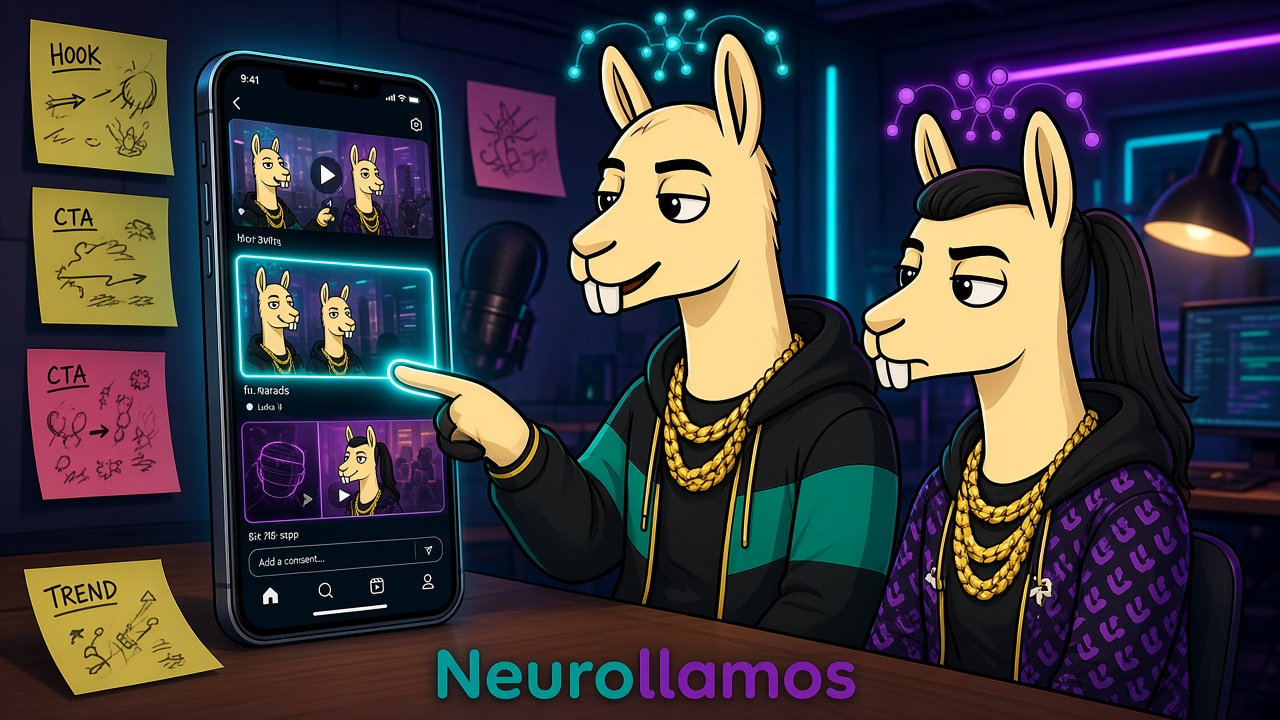
Keep production simple. Every selling Reel should pass through the same four stages: hook, product motion, caption system, and cadence. Skip one and performance usually collapses in a predictable way. Weak hook means nobody watches. Weak motion means nobody trusts. Weak caption means nobody knows what to do. Weak cadence means nobody remembers you when they are ready to buy.
Stage 1: Hooks that earn the next three seconds
The first frame is a contract. It tells the viewer why this clip deserves time. Product brands often open with a logo sting or a slow beauty pan. That is polite. It is also easy to skip. Prefer hooks that name a problem, show a surprising result, or put the product in a use context the shopper already recognizes.
Use these hook patterns as a rotating set, not a formula you repeat until fatigue sets in:
- Problem freeze: Show the messy before state in the first shot, then cut to the product solving it.
- Result first: Open on the finished outcome, then rewind to the product that created it.
- Specific claim: On-screen text with a measurable promise (“holds 8 hours,” “fits under a blazer,” “packs flat in 10 seconds”).
- Contrast cut: Cheap alternative vs. your product in the same setting.
- Founder or character interruption: A consistent face reacts to the product problem, then demonstrates the fix.
Text on screen should be readable in under a second. Keep it under eight words when you can. Avoid vague lines like “game changer” or “must have.” Specificity is the hook. If you use a recurring brand character, lock the face and wardrobe before you scale generation. That process is covered in depth in brand character consistency for Reels, and the practical asset pipeline starts on the character sheet page.
Test hooks the same way performance teams test ads: change one variable at a time. Same product motion, three openings. Keep the winner for two weeks, then refresh before creative decay sets in.
Stage 2: Product motion that proves value
Still photos can look premium. Motion has to look true. Shoppers buy what they can mentally simulate. Your job is to show how the product behaves in a real hand, on a real body, or in a real room. AI helps you generate that motion from limited source assets, but the brief still has to be product-first.
Write every motion brief with four fields:
- Product hero: What must stay accurate (shape, label, colorways, packaging).
- Use action: The one physical action that proves the benefit.
- Environment: A setting your buyer already lives in.
- Camera intent: Macro detail, mid shot for use, or wide for lifestyle context.
Good product motion for commerce is rarely cinematic for its own sake. Macro texture shots sell skincare and fabrics. Fast function demos sell tools and organizers. Fit checks sell apparel and accessories. Unboxing with a clear first-use moment sells kits and gift sets. Pick one proof per Reel. If you try to show every feature, retention drops and the offer gets fuzzy.
When you generate with AI, start from clean source photos and a locked identity pack. Neurollamas is built for this production loop: keep brand assets consistent, then push short clips through the video engine instead of rebuilding every scene from scratch. If a generated clip distorts the label, warps the silhouette, or invents a feature you do not sell, discard it. Speed is worthless when trust breaks.
A reliable shot sequence for a 12 to 20 second selling Reel looks like this:
- Hook frame with on-screen claim (0 to 2 seconds).
- Product in use, one clear action (2 to 8 seconds).
- Detail proof or social-style reaction (8 to 12 seconds).
- Offer or next step card (final 2 to 4 seconds).
That structure is boring on paper and effective in-feed. Boring structures scale. Clever structures usually only work once.
Stage 3: Captions that convert without sounding like ads
Captions do three jobs: reinforce the hook, answer the first objection, and route the next action. Most brands only do the first. Write captions as a short landing page under the video.
A caption stack that works for product accounts:
- Line 1: Restate the benefit in plain language.
- Line 2 to 3: Add proof (materials, use case, who it is for, what it replaces).
- Line 4: Soft objection handling (“no tools needed,” “ships in 48 hours,” “works on oily and dry skin”).
- Final line: One CTA. Not three.
Example shape for a home organization brand:
“This tray stops the junk drawer reset every Sunday. Soft-touch base, dishwasher-safe inserts, fits standard 40 cm drawers. If your counter collects chargers by noon, this is the fix. Shop the tray via the link in bio, or comment TRAY for the size guide.”
Notice what is missing: hype adjectives, emoji walls, and a paragraph of hashtags. Use two to five relevant tags, then stop. Put searchable product language in the caption body, because Instagram search and recommendations still reward clarity. For broader magazine reading on content systems, browse the full Neurollamas magazine index and keep Reels as one channel inside a weekly plan, not a standalone stunt.
Also write the on-screen text and the spoken or captioned line so they match. Mismatch creates cognitive load. Cognitive load kills conversion on mobile.
Stage 4: Posting cadence that compounds
Cadence is not “post every day forever.” Cadence is a repeatable rhythm your team can sustain while creative quality stays high enough to sell. For most product brands with limited production capacity, a strong baseline looks like this:
- 3 Reels per week as the core sales engine.
- 1 authority or process Reel that builds trust without a hard sell.
- Stories that remix the best Reel into polls, FAQs, and swipe-up style reminders where available.
That is four video surfaces a week if you count the trust Reel, or three if you stay lean. Consistency beats binge-and-silence cycles. Algorithms and audiences both respond better to a brand that shows up on a schedule shoppers can learn.
Use a content ladder so you are not inventing topics from zero every Monday:
- Offer Reel: Direct product proof plus CTA.
- Objection Reel: Answer fit, price, durability, or shipping concerns with motion proof.
- Use-case Reel: Same product, different buyer context.
- Social proof Reel: UGC style recreation, review quote on screen, or before and after.
Rotate those four intents across the month. Your catalog can stay small while the angle changes. A single hero SKU can support weeks of Reels if the hook and use case keep shifting.
Timing still matters less than retention, but do not ignore your own data. Post when your account historically earns watch time, then protect that slot for your strongest creative. If you are testing a new market, run the same Reel at two dayparts for two weeks and compare profile visits, not just plays.
Build the weekly production board

A sales-focused Reel week should be planned before anyone generates a frame. Use a simple board with five columns: SKU, buyer job, hook, motion proof, CTA. Fill the board on Friday. Produce on Monday and Tuesday. Publish Wednesday through Sunday. Review metrics the next Friday before you refill the board.
Here is a sample week for a mid-price skincare brand:
- Wed: Hook on midday shine; motion shows blotting and serum absorb; CTA to bestseller set.
- Fri: Objection Reel on “will this pill under makeup”; macro motion under foundation; CTA to shade-free texture demo page.
- Sun: Use-case Reel for gym bags and travel; packing motion; CTA with travel mini link.
- Bonus trust Reel: Founder or brand character explains ingredient choice in 20 seconds; soft CTA to quiz or routine guide.
When production is tight, Neurollamas can compress the middle of that board. Keep your hooks and CTAs human-written. Let the studio handle variants, motion drafts, and resize work so your team spends time on offer clarity instead of timeline cleanup. That division of labor is how AI actually supports selling: it increases iteration speed on a fixed strategy.
Creative QA before you hit publish
Run every AI-assisted Reel through a short checklist. If you skip QA, you will eventually publish a clip that looks polished and still damages trust.
- Does the first second show a reason to stay?
- Is the product recognizable without a caption?
- Does motion prove one benefit a shopper cares about?
- Are colors, labels, and proportions accurate enough for commerce?
- Is there one CTA, visible late enough to feel earned?
- Would a returning customer recognize this as your brand in muted mode?
Muted mode matters. Many people watch without sound. Your on-screen text and product action must carry the story alone. Sound can amplify emotion. It should never be the only carrier of the offer.
For platform-level creative expectations and publishing mechanics, keep Meta’s business documentation nearby. The Meta business help guide on Instagram Reels is a solid operational reference for formats and placement basics. Pair that with independent research on short-form attention. The Reuters Institute has published useful digital news and platform consumption reporting that explains why speed and clarity beat long setups in mobile feeds; start from the Reuters Institute research library when you want audience behavior context beyond vendor blogs.
Measurement that matches the workflow
Do not judge a selling Reel by vanity metrics on day one. Use a two-layer scorecard.
Layer A: Creative health (first 48 hours)
- Average watch percentage
- 3-second or early retention proxy available in your insights
- Saves and shares
- Profile visits from the Reel
Layer B: Commercial health (same week)
- Link in bio clicks or tracked UTM sessions from social
- DM keyword replies tied to the CTA
- Add-to-cart or checkout starts from the landing page used in that caption
- Assisted conversions if your analytics stack can attribute social influence
When Layer A is strong and Layer B is weak, your offer or landing page is the problem. When Layer B is fine but Layer A is weak, rewrite the hook and tighten product motion. This split keeps teams from “fixing” the wrong part of the funnel.
Archive losers fast. Document winners with the hook line, motion type, and CTA used. That archive becomes your brand’s Reel playbook. New hires and freelancers should start there, not from blank prompts.
Common failure modes (and the fix)
Pretty clips that never mention the product job. Fix: rewrite the hook around a buyer problem before you regenerate visuals.
Too many offers in one Reel. Fix: one SKU, one benefit, one CTA. Promote bundles in a separate clip.
Inconsistent faces or brand world. Fix: lock identity with a character sheet, then generate. Random faces read as stock, and stock rarely sells premium products.
Posting spikes followed by silence. Fix: drop to three high-quality Reels a week and protect the schedule for 30 days before you add more.
Captions that only repeat hashtags. Fix: write the caption as a mini sales page with proof and a single next step.
AI artifacts on packaging. Fix: regenerate or composite the real label. Commerce content has a lower tolerance for visual fiction than entertainment content.
A 14-day rollout plan
If you need a concrete start plan, run this two-week sprint.
Days 1 to 2: Pick three SKUs with margin and clear motion proof. Write five hooks per SKU. Choose one brand character or presenter style and freeze it.
Days 3 to 5: Produce nine Reel drafts (three per SKU). Use AI for motion variants, then human QA against the checklist above. Draft captions and CTAs in the same pass.
Days 6 to 12: Publish one Reel per day for seven days, or stick to your three-per-week cadence if daily is too aggressive for your team. Remix top performers into Stories the same day.
Days 13 to 14: Score Layer A and Layer B. Kill the bottom third. Brief the next nine drafts from the winning hooks only.
By the end of two weeks you should know which hook families your audience rewards, which product motions earn saves, and which CTAs produce action. That knowledge is worth more than another hundred random generations.
Where Neurollamas fits in the stack
You do not need a giant crew to run this system. You need a stable brief, a consistent identity, and a fast path from still assets to motion tests. Neurollamas supports that path for product teams that already know what they sell and need tighter execution: character continuity, social-ready outputs, and a video workflow that respects commerce detail. Use the magazine for strategy, the character sheet for identity control, and the social studio when it is time to produce the next batch of Reels that can actually move product.
If you want the adjacent systems that make Reels convert better in a full content week, read the product photo to Instagram week guide next, then keep character work tight with brand character consistency for Reels. Strategy first, generation second, measurement always on.
AI Reels sell when they behave like direct-response creative with better production values. Treat hooks as attention buy-ins, product motion as proof, captions as close, and cadence as compounding. Do that with discipline and your short-form feed stops being a highlight reel. It becomes a sales channel you can run on purpose.